NYC Triathlon 2014

Race Report

FAT OR CARBS?

A l(not so short) look at the two main options for fueling in endurance sports

My Famous Fails

A little recap of my accidents

Race Recap of the Demi-Marathon des Microbrasseries

Race report for this new race, complete with multiple distances, and BEER!!!

Thursday, 30 January 2014

Carbs or Fat? How to Fuel For Endurance Sports

Nutrition is often referred to as the fourth sport in triathlon, because of its importance and impact on performance. This is especially true as you start to participate in longer events, from the Olympic distance, and of course more so for the Ironman, but also for sport-specific events like a Marathon. The questions that often comes up is; what do I eat and when? When I began racing endurance sports, the primary method of fueling that I was aware of were energy gels, or drinks like Gatorade. The gels generally come in 1oz packets that easy to tuck away, open and discard. Usually they have around 100 sugar based calories per gel, and nowadays you can get them in a wide variety of flavors. Most people are familiar with the Hammer, GU, or Probar labels, but it seems like every year more and more companies are entering the market. Some companies try to fill a specific perceived niche in the market, creating gels with all natural ingredients, different sugar types (such as maltodextrin versus sucrose), and I've even seen one that has chia seeds in it.

Now, traditional knowledge has been that your body only contains a certain amount of glycogen (basically stored carbohydrate) that your body can call upon to fuel itself through an endurance event. This is basically where the idea of "carb-loading" comes from, and has probably caused hundreds of thousands to stuff themselves with pasta in the nights preceding a race. On average, most people have about 200 grams or roughly 800 calories of glycogen in their liver, which is the most easily accessible. After depleting those stores, your body will try derive glycogen from other sources like your muscle, as well as fat, but those processes are more difficult. So, considering that you have limited glycogen, you need to make sure that you continually supplement your exercise with additional carbs to compensate and fuel yourself. Performance using this method is pretty easy to see, as many professionals use this method without problem. The constant fuel provides constant energy, and drinking energy drinks provide additional carbohydrates and electrolytes to prevent muscle cramping and proper energy usage.

Depending on how long the activity is, and your individual strategy, most marathon strategies have athletes 1-2 gels every hour, in addition to whatever liquid calories they might be consuming. For longer endurance events life a Half or Full Ironman Triathlon, you'll need more calories to fuel yourself, since you probably
burn more than the 200-300 calories per hour that I just described, and you'll eventually just run out of energy otherwise. It's generally considered easiest to take in calories on the bike, since your water bottles are being carried for you, and it involves less movement than running, which minimizes food/liquid sloshing around in your stomach. Gel's are still a staple on the bike, but many athletes like to use calorie and electrolyte enriched drinks, like Hammer Perpetuem, or energy bars.

Lately, many athletes have started switching to a fat-adapted basis for fueling. Essentially, through a strict obedience to a diet and training regimen, it has been found that your body can be adapted to use fat as the primary source of fuel instead of carbohydrate. The benefit is that since fat is a slower burning energy source, and is practically inexhaustible during a 1 day race, you won't need to consume nearly as many calories during the event. The catch? Your diet has to remain pretty low in carbohydrate (usually around 25% or less) and you have to tailor your training. Even in a a fat adapted state, your body will only use fat as fuel when you exercise aerobically. This means if you go too fast and enter an anaerobic state, your body will switch to using carbohydrates again, and actually stay that way for quite a while, even if you get control of your heart rate. Another potential benefit of this strategy is that by consuming less calories, you minimize the risk of GI issues. While your body is in "performance mode", it becomes harder to break down some food, so the idea is that the less you put in, the less risk of unpleasant effects.
So, which method of fueling works best? That's debatable and deeply personal. Different people might respond differently to each method, and a recent (albeit limited) study showed that as long as your metabolism is accustomed to one of the fuel sources, they will work equally well. I should also point out that even when fat-adapted, its still necessary to consume SOME carbohydrates, so many athletes will drink a honey-water mixture (recommended by Phil Maffetone) as their sports drink alternative.

This may have come as a really long post, but really could have been so much longer. I'd be happy to expand or answer any question that anyone has to the best of my abilities, or at leas point you to someone else for information.

Thanks for reading, keep Tri-ing, and stay safe!

Thursday, 16 January 2014

Looking back and looking forward to 2014

Now that New Year's has come and gone, and events are starting to pop up on my calendar (remember my last post about planning?), I like to pause and look at my overall goals for the past, and set new ones for the coming year. This post is gonna very self-focused, but will be one of the few such posts that I make during the year (aside from race reports, which I try to make useful for all anyways)

Last year my overall goal was to double the distance that I both ran and biked (blog post here), bringing those numbers to a target of about 550 and 650 miles, respectively. Swimming technically should have been there, but I'm pretty bad at keeping count of laps by myself, and my watch doesn't measure pool swimming.

Since I actually do manage to log most of my run/bike workouts in TrainingPeaks, checking is easy and it
turns out I did pretty well. I was pretty much spot on with my running (493 miles), and passed my biking goals, covering over 1200 miles. Looking at distance isn't everything of course, especially when considering that I do races, but the times tend to be skewed because I often leave my watch on after training and races, and it gets added in. I use races and individual training sessions as better measures of my overall pace.

For 2014, I don't want to just double my distances again, since I feel that finding time to train might be getting harder this year as I will have to handle some personal challenges (for lack of a better word) like getting married. Instead, I'll be focusing on the quality of my workouts, making sure that every workout has a point. Also, I've been refocusing on my nutrition both in-race and general life, which I'll be sharing in future posts.

So what are my goals for 2014? Well I've got two Half-Ironman distance races scheduled (Vineman and Princeton 70.3), so from a purely time-based perspective I'd like to go sub-7. It's not such an ambitious goal, but considering the GI issues at my last race I want to be conservative. For running, I want to break the 4 hour mark on any and all marathons I do, and do at least 1:45 on all half-marathons. My time goals might not be crazy competitive to some, but I am after all just an average age-grouper, with other things going on. Though I am extremely passionate about endurance sports, I believe in having a well balanced life.

Just a short post today, so happy training and stay safe out there!


Friday, 27 December 2013

My Famous Fails

"There are two types of riders; Those who have gone down, and those who will"

I don't remember where I heard this adage, intended to reference motorcycle riders, but I feel that it applies perfectly well to cyclists as well. Everyone has a story about either a close call or an actual spill. As an ICEdot athlete, I thought it would be appropriate to share some of my more memorable accidents (yeah, there's been a few).

My funniest falls were probably back when I just started getting into road cycling, specifically when I made the big switch to clipless pedals. When I got them, I was worried that I would't unclip in a high speed accident and risk breaking my leg. The salesmen assured me that wouldn't happen and that they were designed to unclip in that situation. What he didn't tell me was the risk of not unclipping when barely moving. Yup, the first few falls on my brand new bikes were a very slow teeter and collapse while rolling to a slow stop. Literally barely moving, a wobble as I failed to unclip, and just toppled over. Honestly it barely even hurt. Might have bruised my ego more than anything. One time though this happened near an intersection as a city bus was turning and I nearly ended up under of it's wheels. That was pretty scary. Lesson learned from these few falls was that it was pretty important to make sure that I got good at unclipping my pedals quickly and smoothly to make sure I don't look this silly again.

I've also had some more serious falls. One happened to me towards the end of last season, that left me pretty banged up. I was on a long ride, actually coming back from the shop where I bought my bike, having just received a quick tuneup. I was in an area that I'm not entirely familar with, and though i knew I had to get up onto a bridge, and saw it, I wasn't sure where the best place was to get up. Thinking I saw a way, I rode quickly across an empty parking lot. While turning, I was looking up at the bridge to follow the road, and didn't see a small patch of sand. As soon as I rode over it, my wheels went out from under me, I fell, and my bike continued another 10 feet (notice how my shoes unclipped though!). I was on the ground in pain for a minute or so when a women who was waiting at a nearby busstop ran over, telling me that she "heard" the fall. Because I was turning, I mostly hit my side. I ended up with a nice bruise on my hip that lasted over a year, wolverine-style scraps on my arms, and some nice road-rash on my legs/knees. Though it's hard to say because it happened so fast,, I'm pretty sure I hit my helmet to the ground, which is what I think the woman heard Overall, I still consider myself lucky to have walked away without breaking anything

My accidents have been pretty tame compared to some of the high-speed wipe outs my friends have told me about, which is why I'm glad to be part of the ICEdot team and to use their system. Accidents happen, and if they do, it's important that everyone has your information.
Feel free to share some of your famous fails!

Thursday, 12 December 2013

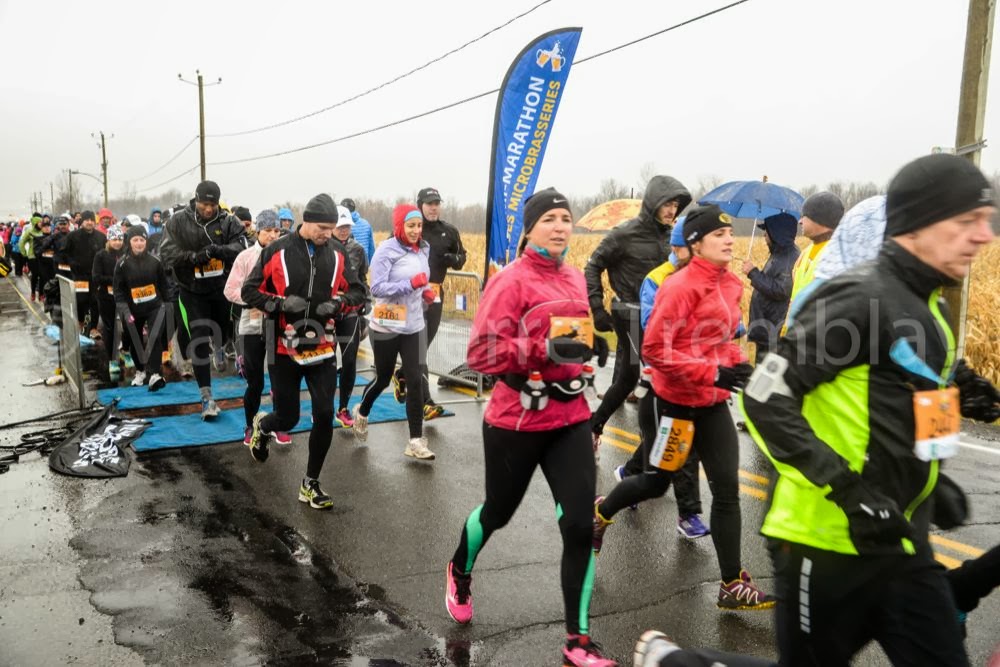
A cold Demi-Marathon des Microbrasseries (Microbrews, hurray!)

Yes. There was beer

I'm Canadian and proud, so have races in the winter seems like a God-given right! With that in mind, this is a recap of my second ever winter race (the first being the Winterman Marathon 2013), which when translated from French comes out to the Microbreweries Half-Marathon. This race is part of the Gourmandes series, which features local food companies from various regions. It was also the first year that that this particular race was held, and from what I've read from the organizers might be last.

The race popped onto my radar by a Team in Training staff member, and what caught my eye was that I would get a free beer flute if I registered early. I don't even drink beer at home much, but hell I can always use a new glass. Online registration was done pretty fast through the Quid-Chrono system (kinda a simplified French version of Sportstats.ca). As the race got closer, the race organizers sent out plenty of emails with information about packet pick-up, travel, parking, race info and the usual "get pumped" emails. The only thing I didn't love was that everything was in French. I don't mind reading French, but going through long detailed emails gets tiring, and makes it easy to miss important information.
Where's Eddie?
Driving to the race was pretty easy, as the site was only about a half-hour from Montreal. The only bad thing was that the parking lot (actually a soccer pitch) was on a side street, so there were dozens if not hundreds of people stuck waiting for the turn signal to be able to go, causing a fair bit of congestion. There was a little office/chalet to huddle before the race, before we all headed out to get ready. They did a good job of keeping music pumping to keep us motivated, but I feel that we stood there longer than we really had to. They started late, meaning we were all waiting outside in the cold without moving for a good 10-15 minutes.
The race itself was pretty nice. Mostly flat with very light rolling hills through quaint neighborhoods with little no to traffic. Honestly I don't even know if the roads were closed, or there is just so little traffic there. Some locals were waving from their windows or doorsteps, which is always nice to see. Water and sports drinks were set up every few kilometers. Nothing special, just the basics here.

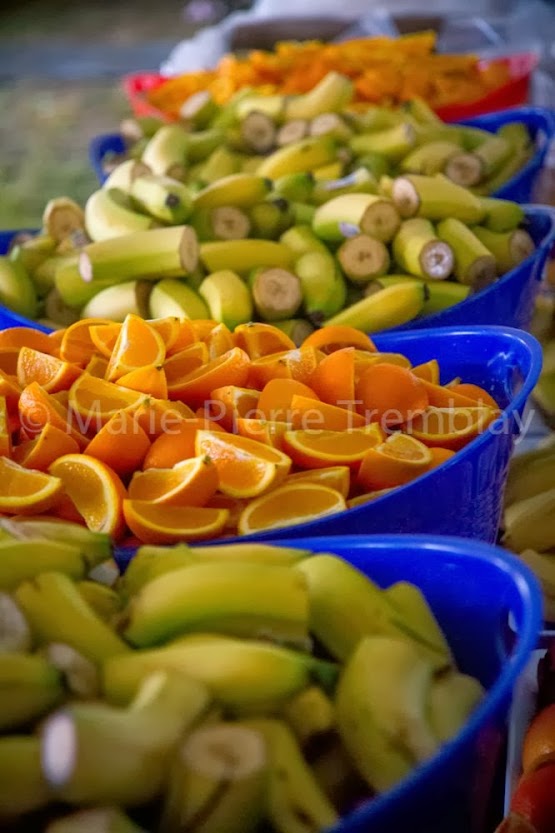
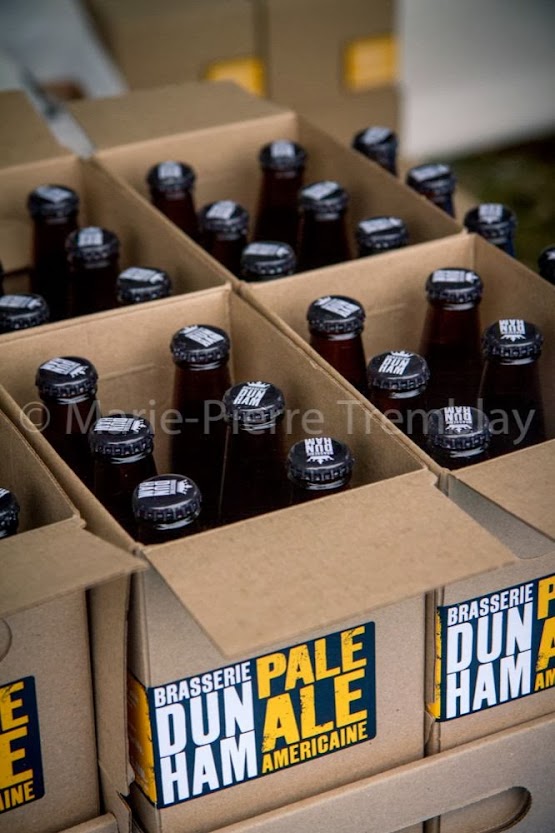
The finish line was where the party really started. There was a great arrangement of fruit, chocolate milk, hot food from local sources and plenty of beer (remember the name of the race?). Unfortunately I was feeling pretty cold, so skipped the beer. However the local McDonald's got in on the action and had a trailer parked and handing out free hot beverages. I helped myself to a hot chocolate with whipped cream because, hey, I just ran a half marathon.

Now is where the trouble started... Something that I didn't mention is that the race was a point-to-point. As in you don't finish where you started. Thanks to only glancing at the all-French emails, I didn't realize that I was a full 18km from the start. The organizers had rented school-buses to shuttle people back to their starting point (were different spots for the 5k, 10k, and 21k routes). The problem is that they only had 2 working buses, which the majority of runners needed to use. Being a race with a few thousand participants, this meant that A LOT of people were stuck standing in the cold, wet and tired, for a while. I think I had to wait a good 30 minutes before being able to get on a shuttle. As much as it sucked, I could forgive the organizers for this one misstep, seeing as it was the first edition of the race, and everything else was pretty much smooth sailing. I finished in 1:49 on the dot, which though I felt like I had given a decent effort, I'm happy with considering I hadn't genuinely trained for it.

This race also marked the official end of my 2013 race season. I took the medal, along with the others from this year and added them to my now quite full shadow box. I'll be on the lookout for other ideas of what to do with medals/bibs.

In the meantime, thanks for reading, feel free to comment below, and keep tri-ing!

Tuesday, 10 December 2013

Catching up

Wow it's been too long since I've gotten a blog post out. I figure I've got about half a year's worth of catching up to do, so I figure the best way to do so without overloading one post will be to spread it out. This post will focus on what's been going on most recently, then I'll add some older race reports in the near future.

So....first big change has been in my nutrition (as the title suggests..duh). I've basically gone Paleo for the past month or so and it's amazing. Paleo (or at least my version of it), means no grains, no dairy, and as little processed sugar as possible. The reason I say that I'm doing it in my own way is because I don't necessarily agree with all the tenets of the Paleo movement, but I agree with the main principles.Fit, Fast, Fat", and doing my own reading, I've decided to give it a go and see how my body reacts. In addition to following the Paleo diet, I also try to focus on reducing my carbohydrate intake in general, focusing instead on consuming healthy fats.
Eating more whole foods is downright better for your body, and after listening to podcasts like "Ben Greenfield Fitness' and "

I can't say all this has been easy. Or cheap. I've slowly begun stocking my kitchen with coconut oil, "Paleo-friendly" flours, non-processed sweeteners, and more Kale than any one person should have. The hard part is coexisting with my family at dinner's, who don't understand all my choices or that I really do feel like I am doing what is best for my health.

The results so far have been pretty awesome. As an endurance athlete, I was already pretty lean, weighing about 160-165lbs. Since switching my diet over, I've dropped down to closer to 155lbs, and lowered my overall body-fat to just over 11%. Keep in mind that just a few years ago, before starting Triathlon, I was weighing in at almost 190. No, it's not Biggest Loser style weight-loss, but I think thats pretty damn good.
Since nutrition is so important, I'm going to add a "Recipes" tab soon and link to posts with good recipes that I've created or found that are simple, healthy, or just really delicious, all made with an ingredient list that you can pronounce.

On the endurance sport side of things, it is officially the off-season! That means a slightly reduced load of the 3 main sports, and putting in some time to improve general conditioning. My personal goal is to use the next few months to regain some muscular strength through weight training. I am also trying to introduce the maphetone method of training, whereas a majority of your training is done below lactate threshold, which happens to also be the point at which your body switched to using carbs as fuel instead of fat. Since it's winter and icy, this is fine by me since sprints and hill training could be a bit dangerous.

Vineman 70.3 2014 - L'chaim!
For next year, I'm starting to build my race list, and the first major race looks like it will be the Vineman 70.3 in California with the Dozer Team! I love how triathlon gives me an excuse to do some traveling to places I've never been. Also, since I'm moving to the New York area soon, I'm looking at races in that general area, which of course there are many. I was lucky enough to win the lottery entrance to the NYC Triathlon, and I'll be sprinkling in a few short course triathlons, as well as some half-marathons, a full marathon or two, and maybe even a Spartan Race.


As always, thanks for reading, and keep Tri-ing!

Tuesday, 9 July 2013

Tough Mudder Montreal 2013


Aside from a quick stint in the Dead Sea, I’ve never really been the type to enjoy putting mud on my body. Apparently it’s quite good for you though, and is supposed to even be relaxing. The Tough Mudder is anything but. On July 7, I participated in the TM just outside of Montreal, alongside a small airport landing strip. Though I’ll be calling this a race report, TM is quick to point out and remind participants that it is a challenge, not a race, and that completion is the point of honor. To that end, there are timing mats, no pacer bunnies, no prizes for finishing faster than the guy next to you.

I’m going to try to cover most of the obstacles in the order that they appeared on the course, to the best of my memory.

My wave started at 10AM, a pretty late start for a race but fine by me, since I had to drive an hour to get to the site. Check-in started a bit late in my opinion but was fairly fast, with many tables to check in at depending on the first letter of your last name. Some quick body-marking and bib-attaching later and that’s it. Actually, not quite. In order to get to the starting corral, participants have to first make their way over the 10 foot  tall “Wall of Pain/Shame”, a kind of warm-up and quick physical test.

After reciting the National Anthem and TM code of honor and much cheering, the “race” began. The off-road nature of the course meant that you had to be careful how you stepped, or easily risk spraining an ankle. With around 20 official obstacles, and a 16km course, there was a good mix of running and obstacles to keep you entertained even if you find running boring.

The first obstacle, Arctic Enema, involved jumping into a cargo container filled with ice-water and swimming to the other end, bobbing under a couple of planks at surface level along the way. For the first few seconds it wasn’t so bad, then I realized just how cold it was and breathing started to become difficult, but by then I was almost out.

After that was some more mud-covered ground with some natural hill/mud pits. The next major obstacle involved crawling in mud under barbedwire while being sprayed with water. Not really challenging per se, but I had to make sure to really hug the ground to avoid some low hanging wire. Muddy for a few minutes, Iquickly came up to the next obstacle, the Boa Constrictor which had me crawling and sliding down a pipe into a water hole, then trying to make my way up another pipe, which was a bit more difficult since the wetness made finding a grip pretty tough.

OK, at this point I’m gonna start forgetting which obstacles came in what order, but basically there was a fair bit of crawling through mud, running/walking in mud, and general mudiness. There was the “Berlin Walls” obstacle, with 2 10-foot walls, which participants were generally very friendly and were helping each other mount. Same goes for Everest, where you had to run up a half-pipe ramp. Though theoretically possible to do on one’s own, most were helped along by grabbing the arms of waiting mudders. In general, participants across the course were very friendly and helpful to each other.

The most memorable (and painful) obstacle was by far the Electric Eel. This obstacle has participants crawl in the mud and water under dangling wires that electroshock you if you get to close! According to TM, the shocks can be up to 10,000 volts. The craziest part is that because you are wet, you don’t even have to be touching a wire to get shocked. I started as low down as I could get, but still got shocked quite a bit. I was expecting it to feel like a jolt, the way you sometimes get when touching someone after walking on a shag carpet. Instead, the shocks felt to me like punches, and for some reason they focused on the left side of my lower back. I really wanted to get out fast.

Aside from the Electric Eel, some obstacles were actually pleasant, like Walk the Plank, where you climb up some angled scaffolding and then jump about 15 feet into water. Unless you’re really afraid of (average) heights or water, there was really nothing to it. According to the TM website, there was supposed to be some fire-jumping and obstacles involving smoke, but I guess due to local permit restrictions these obstacles were left out.

At the end of the course you had to jump some 5 foot pits, and then face off against a larger version of the Electric Eel, with two valleys with wires divided by a small hill. In this one you could actually stand and run, or risk crawling through. I chose to scream, cover my head and charge, somehow making it to the hill without feeling any shocks before diving under the second set. The I just mud-crawled my way under the remaining and came out unschocked (but completely covered in mud).

After crossing the finish line, I was awarded with the staple Tough Mudder orange headband, finishers t-shirt, and a can of Dos Exes beer. Then, courtesy of Samsung I got a giant bubble bath before hitting the shower (actually a bunch of high pressure garden hoses lined up.


All in all, a fun “race”. Maybe not quite the toughest thing in the world as advertised, but definitely challenging. Make sure to bring along a few friends if you are going to do a Mudder, because it makes the experience way more memorable.


Friday, 28 June 2013

2013 Mont Tremblant 70.3 Race Report


My first 70.3
This past Sunday, I raced my first Ironman 70.3 in Mont-Tremblant, Quebec. Though my race did not go as I wanted, it was by all other accounts a great race.
The race weekend began on Friday, with athlete check-in (also available Saturday) taking place in the main Mont-Tremblant village, which is in itself a picturesque vacation village. The resort village looks somewhat what I would expect of an old town in Switzerland, with colourful roofs and quaint storefronts.
Friday
Check-in was quick and painless. All I had to do was bring a piece of ID, find my bib number from a wall of athlete names. From there I was given some consent and emergency contact forms (OK, maybe a bit overboard here, I felt like I was getting a mortgage) which didn’t take too long to get through. Next, everyone had to get weighed. I’m assuming this is for medical purposes, such as if a participant passes out during the race, it would be important to know their original body weight to determine how much fluid loss occurred. After that, I just simply moved down a line to pick up my goodie bag,  swimcap, race chip, free t-shirt, merrel headband-y thing, identifying wristband, and that’s it.  The goodie bag is actually a pretty nice version of your typical 2-string backpack. Inside was just some local flyers, a 2-pack of deodorant (like it would help over the course of a 70.3).
Saturday
Bike check-in was on Saturday, which again was simple and clean. The transition area was easily navigated, with signposts and name markers for each spot. Later in the afternoon was a mandatory athlete briefing, where various speakers went over some rules (such as not needing to wear a number bib on the bike) and some course details. Really most of the course specifics was redundant to anyone who had read the athelete guide, which I’d be surprised if anyone had not at that point.
Race Morning (Sunday)
Transition and body marking began around 5am lasting until 6:20. Since I was in the last starting wave at 8:05 (IM has recently introduced wave starts instead of mass starts for safety reasons), I went towards the end of the allowed time, quickly set up my transition, got marked, then headed back to my hotel room. Unfortunately my stomach was feeling a little off, which I attributed to pre-race jitters. Though I would normally stay for a quick warm up swim, I didn’t feel like “hanging out” for 2 hours, not to mention that warm-up swims would not be allowed once the first wave started.
By my fault alone I got to my wave corral pretty late because I was unsure of where it was, and I was doing some last minute packing Sunday morning. With maybe 5 minutes to spare, I quickly slipped into my wetsuit (more like squeezed into), and ran to my corral. Shortly after I was lining up and then with a bang was running towards the water. Immediately the cold water caused my chest to contract making it hard to breathe properly. Also not helping was that my brand new goggles (no choice, lost my regular pair) did not fit properly and my right goggle kept filling with water. Within a few minutes I started to breathe more or less normally but I was pretty far at the back of the pack. A slow swim for me, and with the aid of a couple of cayaks guiding me, I got through the swim in 58 minutes.
Coming out of the water, I realized my stomach was giving me serious issues, so my T1 took a little longer than it should have for a potty break. After that I was on the bike. Being in the last wave and one of the last out of the water at that meant that most of my ride was alone, mostly seeing athletes coming the other way.


For most of the bike, I was actually surprised that the elevation profile wasnt as bad as it had seemed when I looked it up earlier. In the first 70km, there were maybe 2 or 3 big hills, but aside from that fairly flat/rolling terrain. Looking at my watch, I seemed to be on a pretty good pace. The big challenge came in the last 10km or so, going up Montee Ryan. What a bitch! I was forced to get off my bike and walk a few times, again not helped along by my cramping stomach. By the time I pulled into T2, I been biking for 4:10, and missed the bike cut-off by maybe 5 mins.


A quick transition later I was on the run. Leaving the village was a little hilly, and my overall fatigue had me walking up some of the larger hills. at about 5km I met up with a nice couple from Ottawa who were doing a 1 minute walk, 15 second run pattern, so joined them for a bit until about 9km, at which point that I might be pushing the course cutoff once again, so tried to do more running. Still having stomach issues, I had to stop again for some potty time. From aroun 15-19 began walk/running with a former TeaminTraining participant from NY, and then pulled ahead, sensing the finish line.


The last kilometre was great, the last 500M even better, as I began running into the Tremblant village, and down the finishers shute. I finished my first 70.3 Ironman at 8:10:00 , and though not happy with my results, am still happy to say that I did it.

For after the race is a nice lineup of typical post-event food for participants, bagel, fruit, yogurt, chocolate milk and so on. Bike pickup was painless with just a flash of the wristband to match with your bike number and the day was over.


I highly recommend this race to anyone who dares take on a few challenging hills amidst beutiful scenery. My race could have gone better, but after taking a month and a half off due to injury (and getting engaged), and a less than 100% race day, I still feel like I got my full IM experience.